
Back in 2016, Sony launched its 100-inch television with a price tag of approximately £60,000. That’s not a typo. For that money, you could have bought a rather nice car, or placed a deposit on a house.
Fast-forward to 2026, and 100-inch 4K televisions are available for around £2,000–£3,000, depending on the model and specification. That’s a rather spectacular change in the market and makes enormous screens a realistic proposition for many households.
Now you no longer need a millionaire’s bank balance to enjoy a truly enormous picture in your living room. A 100-inch television, once the preserve of the super-rich, can now be purchased for a fraction of the price of a family hatchback. And if you fancy something even bigger, a home cinema projector can deliver an image measuring 120, 130 or even 150 inches.
If you are fortunate enough to have the space which is better? Is a 100-inch TV the ultimate home entertainment solution, or does a projector still offer the most cinematic experience?
The 100-Inch TV: The Big-Screen Revolution
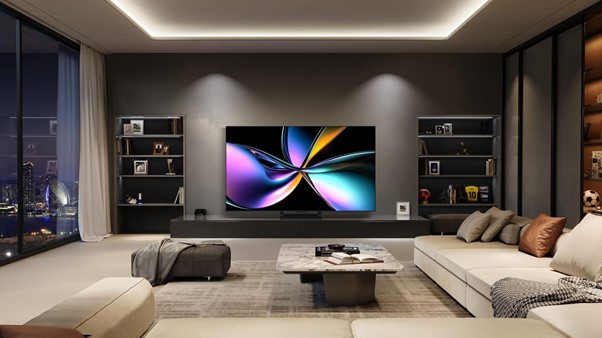
Most affordable 100-inch televisions use LCD panels with LED backlighting, often incorporating QLED technology to improve colour and brightness. More sophisticated models use Mini-LED backlighting, which allows much finer control over brightness and contrast.
The results can be genuinely impressive. You get a huge, detailed 4K picture, vibrant colours, and enough brightness to make even the most spectacular Hollywood explosion look as though it’s happening in your own home.
And the television’s trump card? it works brilliantly in daylight for everyday practical use.
Unlike a projector, a television produces its own light. It doesn’t rely on reflecting an image from a screen, so it remains bright and colourful even when the sun is streaming through the windows.
You can watch the football on a Saturday afternoon, enjoy a film in the evening and the kids can play their favourite console game without having to close every blind in the house. This makes a 100-inch TV particularly well suited to a family living room where the television is used for everything.
There is, however, a small problem. A 100-inch television is enormous. At approximately 2.2 metres wide, it is less of a television and more of a piece of architecture. Getting it through the front door, mounting it securely and finding somewhere suitable to put it all require a little planning.
Oonce it’s installed, life is easy. Pick up the remote, press the button and away you go.
100-inches does seem to be the sweet spot due to the screen technology. Beyond that size the prices start to skyrocket again.
The Home Projector: Bigger Is Better. Isn’t It?
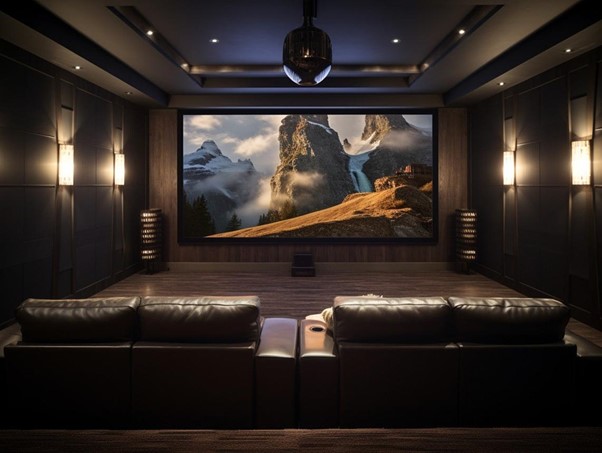
If a 100-inch television is impressive, a 150-inch projected image is something else entirely.
This is where projectors make their case. They can deliver a picture considerably larger than even the biggest mainstream televisions, often at a lower cost per inch. And when you’re watching a blockbuster, the sheer scale can be breath-taking.
Imagine watching a film on a screen that fills much of your field of vision. Explosions are bigger, landscapes more immersive and cinematic moments feel considerably more dramatic. It’s the sort of experience that makes you wonder why you ever bothered going to the cinema in the first place.
Modern laser projectors have also transformed home cinema. They offer improved brightness, excellent colour reproduction and long operating lives compared with older lamp-based models. Pair one with a quality screen and a carefully designed room, and the results can be spectacular.
But, as the saying goes, there’s no such thing as a free lunch. Projectors rely on reflected light, which means ambient light is their natural enemy. Open the curtains, switch on the lights and that beautiful image can quickly lose its contrast. Dark scenes become grey, colours lose their punch, and the cinematic magic starts to disappear.
For this reason, projectors are particularly well suited to dedicated cinema rooms or living spaces where lighting can be controlled. Blackout blinds, suitable wall colours and a good projection screen can all make a significant difference.
Installation is also more involved. You need to consider the projector’s throw distance, mounting position, screen size, alignment, focus and cable routing. Ultra-short-throw projectors can reduce the distance required, but they still need careful positioning.
In short, a projector can deliver a spectacular experience, but it’s not quite a case of plugging it in and hoping for the best. Unless, of course, you enjoy watching a trapezoid-shaped image on the ceiling.
Picture Quality: Brightness Versus Cinematic Scale
So, which delivers the better picture?
For everyday viewing, a television generally has the advantage. Its brightness, contrast and consistency make it ideal for mixed-use environments, particularly rooms with windows and variable lighting.
A projector, however, can be more immersive in a properly controlled environment. The larger image creates a genuine cinema experience, and high-quality laser models can produce excellent detail and colour.
Neither technology is inherently better in every situation. A premium projector in a dedicated cinema room may be a more satisfying experience than a television, while a 100-inch TV in a bright family living room will usually be more practical.
It’s rather like comparing a convertible car with a 7 seater. Both can be brilliant, but you’d be disappointed if you bought the wrong one for your needs.
Don’t Forget the Sound
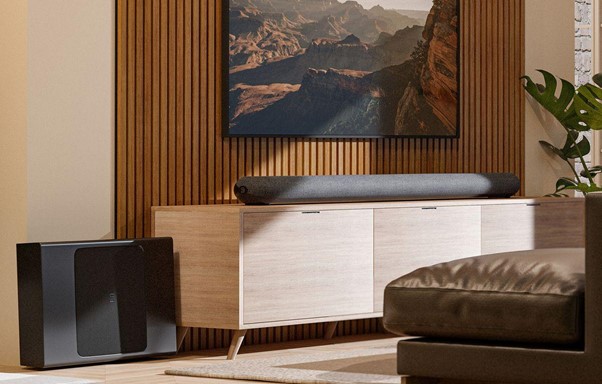
A big picture deserves big sound to match. Unfortunately, even the best television speakers are unlikely to deliver the scale and impact of a proper home cinema system.
A traditional 5.1 surround sound installation, comprising an AV receiver, five speakers and a subwoofer, might cost in the region of £2,000–£15,000, depending on equipment quality and installation complexity. Dolby Atmos systems can cost more.
For those who prefer a cleaner installation, both Sonos and bluesound offer an alternative. A system comprising a PULSE CINEMA soundbar, PULSE subwoofer and two PULSE FLEX rear speakers provides Dolby Atmos support and immersive surround sound without filling the room with equipment and cables.
Using indicative equipment prices, the system totals approximately £2,600. The subwoofer and rear speakers connect wirelessly, although the rear speakers still require power.
A traditional AV receiver and separate speakers offer greater flexibility for upgrades and positioning, while a wireless system provides a convenient, less intrusive solution. Both can deliver excellent results when properly specified.
The Verdict: TV or Projector?
So, is it better to have a 100-inch TV or a home projector?
If you want a huge screen that works brilliantly throughout the day, is easy to operate and handles films, sport and gaming with equal confidence, a 100-inch television is an excellent choice.
If your priority is the ultimate cinematic experience, you have a dedicated room where lighting can be controlled and you want an image that goes beyond 100 inches, a projector could be exactly what you’re looking for.
The key is to choose a system that suits your room and lifestyle rather than simply buying the biggest screen your budget allows. After all, there’s little point spending thousands on a projector if you spend every evening watching it struggle against the afternoon sunshine.
Let Simply Sound and Vision Help
The good news is that you don’t have to figure it all out yourself.
At Simply Sound and Vision, we can advise, design and supply a home entertainment system tailored to your room, your budget and the way you actually live. Whether you’ve already decided on a 100-inch television, are leaning towards a projector or haven’t the foggiest where to start, our team can help you explore the options without the technical jargon.
And if you’d rather leave the tricky bits to someone else, we can take care of the installation too. From selecting the right screen and positioning your speakers to concealing cables and configuring the system, we’ll help turn your ideas into an entertainment experience you’ll love.
Whatever your preference, Simply Sound and Vision can advise, design, supply and install (if required).
Because the best home cinema isn’t necessarily the biggest or most expensive. It’s the one that makes you look forward to watching.